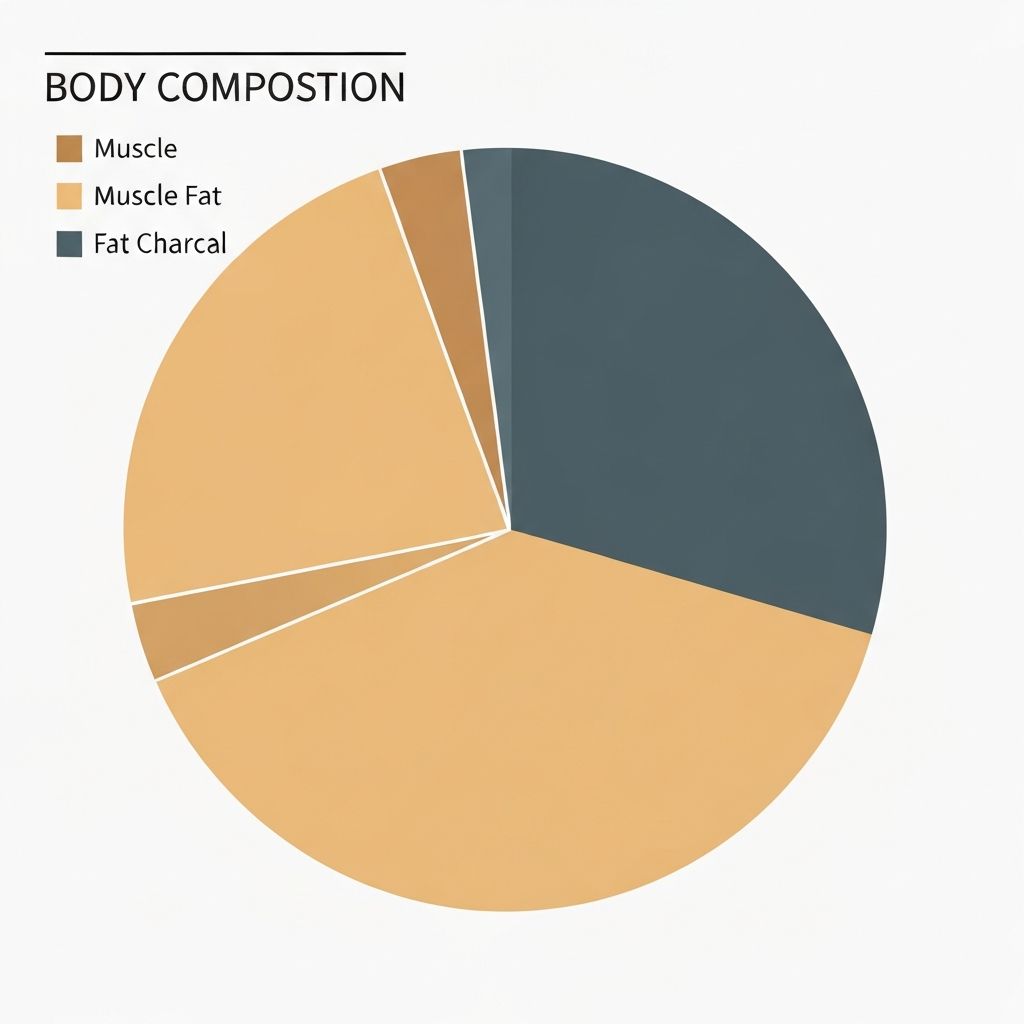
Metabolic Contributions of Lean Body Mass
Lean body mass—comprising skeletal muscle, organs, bone mineral, and other non-fat tissues—accounts for the majority of resting metabolic rate despite representing only a fraction of body weight. Muscle tissue alone accounts for approximately 20–30% of resting metabolic rate despite being only 40–50% of body weight.
Different tissues contribute variably to metabolic rate. Skeletal muscle is moderately metabolically active. Organs (brain, liver, heart, kidneys) are highly metabolically active per unit mass. Bone and connective tissue contribute minimally. Understanding these differential contributions contextualises why lean mass loss substantially affects metabolic suppression.
Body Composition Changes During Energy Restriction
Weight loss typically includes both fat mass loss and lean mass loss. The proportion varies substantially between individuals depending on energy deficit magnitude, diet composition, exercise patterns, protein intake, and individual genetic factors.
Controlled studies show that lean mass loss typically accounts for 20–35% of total weight loss, though this varies considerably. Very severe energy deficits produce greater lean mass loss proportions. Adequate protein intake and resistance training can reduce lean mass loss proportion.
Research Context
Dual-energy X-ray absorptiometry (DEXA) and other body composition assessment methods consistently show lean mass loss during energy restriction. The proportion of lean mass loss varies with deficit severity: moderate deficits (~500 kcal/day) produce approximately 25–30% lean mass loss of total weight loss, while severe deficits (1000+ kcal/day) produce greater lean mass loss proportions.
Impact on Resting Metabolic Rate
Weight loss that includes significant lean mass loss produces greater metabolic suppression than weight loss with preferential fat loss. Conversely, weight loss that preferentially spares lean mass shows less metabolic suppression relative to fat loss quantity.
The mathematical relationship is not perfectly linear, but the principle is consistent: greater lean mass loss is associated with greater metabolic suppression. This is one mechanism through which individual differences in metabolic adaptation emerge.
Skeletal Muscle and Metabolic Rate
Skeletal muscle is the largest single contributor to lean mass mass and substantially influences metabolic rate. Muscle tissue has a baseline metabolic rate of approximately 6 kilocalories per kilogram per day at rest, contributing meaningfully to total resting metabolic rate.
During energy restriction, muscle protein loss reflects both adaptive (intended for energy provision) and maladaptive (unintended consequence of deficit) processes. The degree of muscle loss varies with resistance training status, protein intake, deficit severity, and individual factors.
Organ Tissue Contribution
Organ tissues (brain, liver, heart, kidneys) have very high metabolic rates per unit mass—approximately 200–300 kilocalories per kilogram per day. Despite representing only a small proportion of body weight, organs account for a substantial proportion of resting metabolic rate.
Organ mass generally remains relatively stable during moderate weight loss but may decline slightly during severe restriction or sustained weight loss. Organ tissue loss, though small, contributes to metabolic suppression and can be partially reversed with weight restoration.
Key Research Observations
Metabolic imaging studies show organ tissue preservation during moderate weight loss but some decline during severe restriction. Lean mass loss measured by DEXA correlates with metabolic suppression magnitude. Weight loss with preserved lean mass shows less metabolic suppression than weight loss with substantial lean mass loss.
Bone Mineral Density Changes
Bone mineral density typically declines modestly during weight loss, particularly in women and in sustained weight loss contexts. This reflects both reduced mechanical loading from lower body weight and potential hormonal factors (reduced estrogen, altered growth hormone and IGF-1).
Bone mineral loss contributes minimally to metabolic suppression (bone is not metabolically active) but reflects physiological changes accompanying weight loss. Resistance training and adequate protein intake can attenuate bone mineral density loss during weight loss.
Resistance Training and Lean Mass Preservation
Resistance training during energy restriction attenuates lean mass loss and helps preserve metabolic rate. Individuals engaging in resistance training during weight loss show smaller proportions of lean mass loss relative to fat loss compared to individuals without resistance training.
The effectiveness of resistance training in lean mass preservation depends on training volume, intensity, frequency, and protein intake adequacy. Resistance training signals mechanical demands for muscle preservation, opposing lean mass loss from energy deficit.
Protein Intake and Lean Mass Preservation
Adequate protein intake helps preserve lean mass during energy restriction. Higher protein intakes (approximately 1.6–2.2 grams per kilogram of body weight) support greater lean mass preservation than lower intakes during weight loss.
Protein preserves lean mass through multiple mechanisms: it provides amino acid substrates for muscle protein synthesis, creates greater thermic effects than carbohydrate or fat, and supports satiety. The combination of resistance training plus adequate protein intake maximises lean mass preservation during energy restriction.
Individual Variation in Lean Mass Loss
Individual variation in lean mass loss proportion is substantial. Factors contributing include baseline muscle mass, training history, genetic predisposition, protein intake adequacy, resistance training engagement, energy deficit magnitude, and individual hormonal factors.
Individuals with higher baseline muscle mass often show smaller proportional lean mass loss. Trained individuals typically show greater lean mass preservation. These factors contribute to individual differences in metabolic suppression magnitude during weight loss.
Long-Term Implications of Lean Mass Loss
Lean mass loss during weight loss has long-term metabolic implications. The reduced metabolic rate persists after weight loss even with weight restoration if lean mass is not recovered. Weight regain typically restores fat mass preferentially, leaving lean mass depleted.
This creates a metabolic disadvantage for subsequent weight loss attempts—individuals who have previously lost weight often show reduced metabolic rate at any given body weight compared to never-weight-loss individuals. This contributes to the observed difficulty of sustained long-term weight management after weight loss.
Lean Mass Restoration
Lean mass can be partially restored through resistance training and adequate nutrition during and after weight loss, or during subsequent weight maintenance phases. However, complete restoration to pre-weight-loss lean mass levels often does not occur, particularly if long-term caloric balance is not achieved.
This underscores the importance of lean mass preservation during weight loss through resistance training and adequate protein intake—restoration after loss is less complete than preservation during loss.